
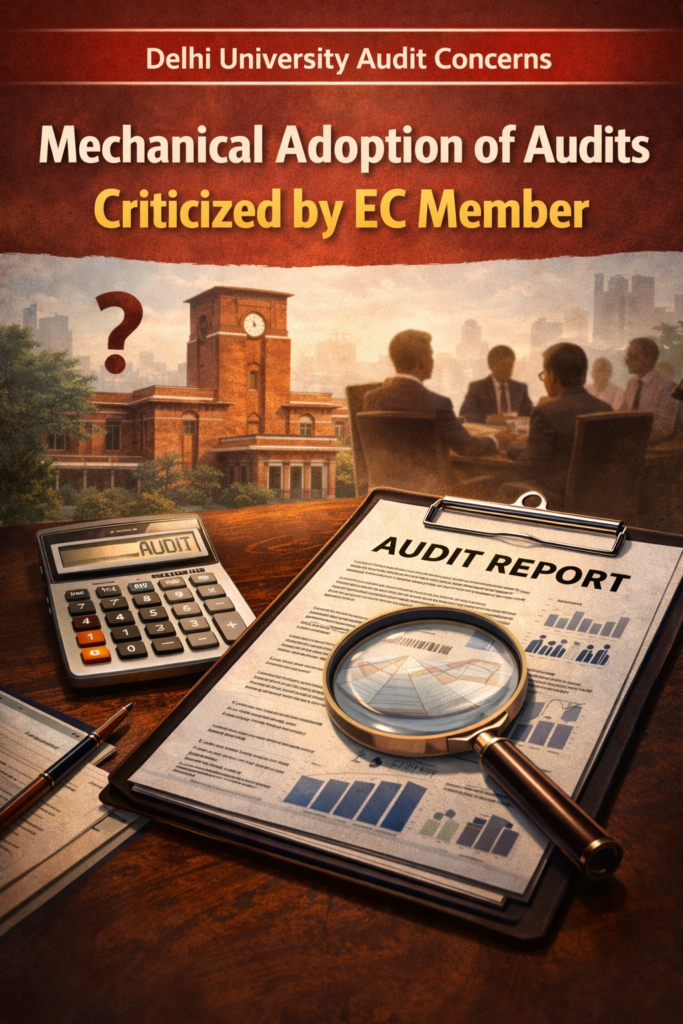
Concerns have been raised within Delhi University’s decision-making bodies regarding the mechanical adoption of audit reports by various university panels. According to recent developments, an Executive Council (EC) member has formally questioned the manner in which audit observations are being accepted without adequate discussion or academic scrutiny.
The issue came to light during a meeting of the university’s statutory bodies, where it was pointed out that audit recommendations are often approved as a routine procedural step rather than being examined in detail. The EC member expressed apprehension that such a practice could undermine the autonomy and academic integrity of the university.
Audits are meant to function as tools for accountability and financial transparency. However, the concern highlighted was that when audit reports are accepted without deliberation, they may fail to account for the complex academic and administrative realities of a large public institution like Delhi University. Mechanical approvals, critics argue, risk reducing governance to a mere formality.
The EC member reportedly stressed that university panels should engage critically with audit findings, assess their implications, and ensure that recommendations align with academic priorities and institutional needs. Blind adoption, they warned, could lead to policy decisions that adversely affect departments, faculty members, and students.
This development has once again brought attention to broader governance challenges within Delhi University. Over the past few years, faculty representatives and academic bodies have repeatedly called for more transparent, participatory, and discussion-driven decision-making processes.
Observers note that universities require a balanced approach — one that upholds financial discipline while also respecting academic freedom and contextual judgment. As debates continue, many within the university community are hoping for reforms that encourage meaningful dialogue rather than procedural compliance.
The issue is expected to be discussed further in upcoming meetings, as stakeholders push for a more thoughtful and accountable approach to institutional audits and governance.