
Protests and debates continue to unfold across major university campuses in Delhi after the Supreme Court of India temporarily stayed the University Grants Commission’s (UGC) new equity regulations — officially known as the Promotion of Equity in Higher Education Institutions Regulations, 2026. The controversy has sharply divided student communities at both Delhi University (DU) and Jawaharlal Nehru University (JNU), highlighting broader tensions around caste, fairness, and institutional accountability in higher education.
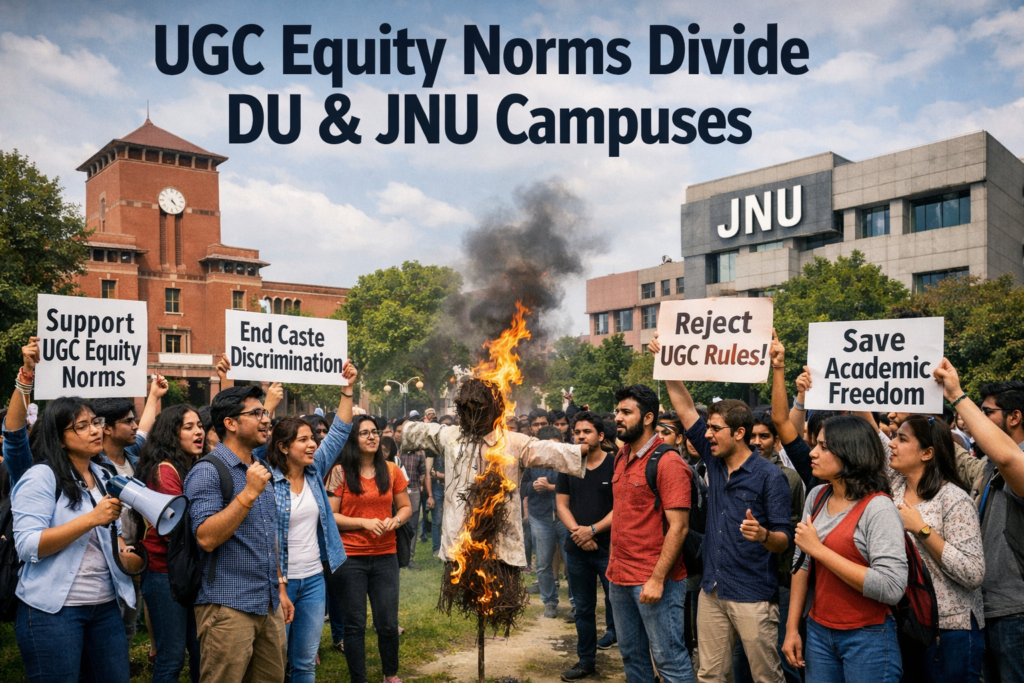
At JNU, students gathered outside Sabarmati Hostel with demonstrations expressing both support and opposition to the UGC norms. One faction of protesters — opposing the stay — symbolically burned an effigy representing “Brahminism,” which they described as entrenched caste privilege. These groups argue that the regulations are essential to ensuring equality, combating discrimination, and addressing deep-rooted social hierarchies on campus. Meanwhile, students on the other side have objected to aspects of the new rules, viewing certain provisions as ambiguous or open to misuse.
Parallel protests were also organized at Delhi University, primarily led by the Students’ Federation of India (SFI) Delhi. These students strongly condemned the Supreme Court’s stay order, calling it a “setback” to efforts aimed at strengthening protections against discrimination and exclusion in academic environments. Protests included slogans, public discussions and assemblies focused on the need for stronger equity measures.
Beyond campus rallies, student groups such as the All India Students’ Association (AISA) have taken the movement further by organizing larger gatherings at Jantar Mantar in New Delhi. AISA leaders have linked the campus unrest to wider demands for national legislative action — including calls for the enactment of the Rohith Vemula Act, aimed at ensuring enforceable mechanisms for justice in caste-based discrimination cases across universities.
The Supreme Court’s stay means the 2012 UGC equity framework will continue to operate for now, while legal proceedings on the 2026 regulations continue. Supporters of the new rules argue that they were drafted to modernize anti-discrimination protections, while critics contend that parts of the text are flawed or could be misapplied. This has brought India’s higher education policy into sharp focus, sparking heated discussions among students, faculty, and policymakers alike.
The current divide at DU and JNU reflects broader academic and political tensions over caste, fairness, diversity, and institutional autonomy in Indian universities. As legal scrutiny unfolds, both student activism and public debate show no signs of slowing down — underscoring the complex intersection of education, justice, and social equity.